

Executive Hiring
Thought Leadership
Executive Recruitment
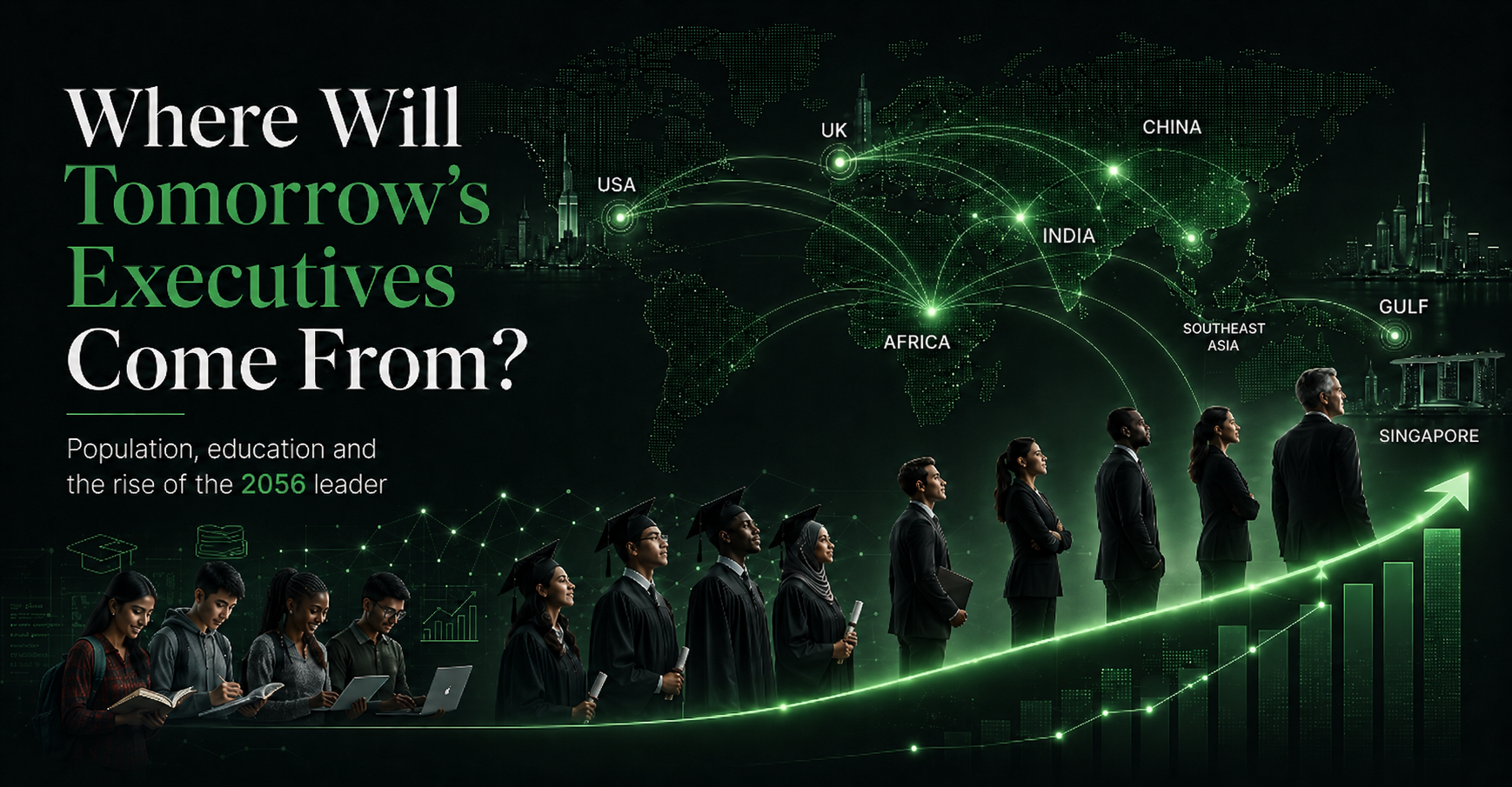

The graduates starting work today will be roughly 51 to 55 years old in 2056, which is prime age for CEOs, CFOs, COOs, CIOs, CDOs, founders, partners and senior public-sector leaders. So the real question is not simply “where will the population grow?” It is:
Which countries will produce large numbers of educated, globally mobile, technically fluent people who get access to the right companies, capital, mentors and operating experiences early enough to become executive leaders by the 2050s?
Ductio view: the future executive class will be far more multipolar than today. The US, UK and Western Europe will still matter, but they will become more like finishing schools, capital markets, governance hubs and accelerators. The largest underlying talent pools will increasingly come from India, China, Africa, Southeast Asia and diaspora corridors.
If Ductio clients are thinking 30 years ahead, the strongest future executive pools are likely to come from these clusters:
| Rank | Future executive source | Why it matters |
|---|---|---|
| 1 | India and the global Indian diaspora | Huge graduate volume, STEM depth, English fluency, global mobility, US/UK/Gulf links, growing domestic companies |
| 2 | China and Greater China | Massive STEM and research scale, deep industrial base, AI and engineering capability, but less open global mobility |
| 3 | US-educated global talent | The US remains the strongest executive formation ecosystem because of capital, elite universities, tech companies and founder networks |
| 4 | Africa, especially Nigeria, Kenya, Ghana, Egypt, South Africa, Ethiopia and Morocco | Fastest demographic growth, improving education base, large diaspora, but quality and completion gaps remain the constraint |
| 5 | Southeast Asia: Indonesia, Vietnam, Philippines, Malaysia, Singapore | Large young populations, manufacturing shift, digital growth, English/mobility advantages in parts of the region |
| 6 | Gulf talent hubs: UAE and Saudi Arabia | Less about native population scale, more about capital, AI adoption, infrastructure, global talent attraction and state-backed transformation |
| 7 | Europe, UK, Nordics, Netherlands, Germany, France | Smaller and ageing, but still strong in governance, regulation, science, sustainability, industrial leadership and advanced research |
| 8 | Latin America: Brazil, Mexico, Colombia, Chile | Large markets and strong regional operators, but less likely to dominate the global executive pool unless education and capital access accelerate |
The highest value future executive will often not be “from” one country. They may be born in India or Nigeria, educated in the US or UK, trained in a global technology or consulting firm, then scale a company in Dubai, Singapore, London, Lagos, Bangalore or Toronto.
That matters for Ductio clients because the future of succession planning will sit across education, migration, first employer, sector exposure, founder experience, capital access and diaspora networks, not just CV seniority.
The UN’s latest population work shows the global population moving from about 8.2 billion in 2024 to 9.7 billion in 2050, with the strongest growth coming from Sub-Saharan Africa. Europe and North America are broadly stable, while many advanced economies and China face population decline or ageing. (INED)
This creates a major shift. By the 2050s, the largest youth and early-career pools will increasingly sit outside the traditional Western executive markets.
But population alone is misleading. A large population without tertiary education, employability, English or global company exposure does not automatically produce global executives. The real equation is:
Population scale × higher education access × academic quality × English/global mobility × first employer quality × capital access × leadership opportunity.
That is why India looks stronger than raw population alone. It has population scale, high graduate output, English-speaking talent, technical depth, diaspora pathways and exposure to global services, technology, consulting and finance.
Africa has the biggest demographic upside, but the executive pipeline depends heavily on whether tertiary access, completion, employability and global company exposure improve quickly enough.
Global higher education has expanded dramatically. UNESCO reported that worldwide higher education enrolment rose from about 100 million students in 2000 to 269 million in 2024. But access is uneven: Western Europe and North America are around 80% gross enrolment, Latin America and the Caribbean around 59%, Arab States 37%, South and West Asia 30%, and Sub-Saharan Africa only 9%. (UNESCO)
That tells us something important: the next executive class will not just come from the biggest countries. It will come from countries that convert young people into high-quality graduates.
UNESCO also notes that global graduation rates have not risen as quickly as enrolment, with the global gross graduation ratio moving only from 22% in 2013 to 27% in 2024. (UNESCO)
India is the most important country to watch.
India’s higher education system already has huge scale. Official Indian government data shows total higher education enrolment of about 43.3 million students in 2021/22, with 10.7 million pass-outs in that year and about 9.85 million STEM enrolments. Female enrolment has also grown significantly, which matters for the future leadership pool. (Press Information Bureau)
India also has strong global mobility. In the US, India became the leading country of origin for international students in 2024/25, with 363,019 Indian students, ahead of China. (IIE Open Doors)
Why India matters:
The constraint is quality dispersion. India has world-class institutions and world-class talent, but also a very long tail of uneven educational quality. The future executive signal will come from filtering the top layers: IITs, IIMs, IISc, leading private universities, elite state institutions, global postgraduate pathways, top Indian startups, global capability centres, consulting, banking, product companies and founder networks.
Implication: India should be treated as a core 30-year executive pipeline. Not just “Indian executives”, but Indian-born, Indian-educated, Indian-diaspora and India-trained operators across the US, UK, UAE, Singapore, Canada and Australia.
China will remain one of the most important executive-producing systems, but in a different way from India.
China is already producing enormous graduate numbers. The Chinese government projected 12.22 million college graduates in 2025, an increase of 430,000 from the previous year. (State Council of China)
China also dominates research output in several measures. In the Nature Index 2025 Research Leaders table, based on 2024 research outputs in selected high-quality journals, China ranks first by research share, ahead of the United States. (Nature)
Chinese universities are also being pushed hard toward strategic fields such as artificial intelligence, integrated circuits, biomedicine and new energy. Reuters reported that leading Chinese universities have been expanding undergraduate places in nationally strategic disciplines, partly in response to China’s ambition to become a leading education nation by 2035. (Reuters)
Why China matters:
The constraint is geopolitical and mobility-related. Chinese executives may be less globally mobile than Indian, European or Southeast Asian executives because of regulatory, political and market-access barriers. But China will still produce a deep pool of technical, industrial, supply chain, AI and manufacturing leaders.
Implication: China should be tracked as a major source of technical and industrial executives, especially in AI, energy transition, robotics, manufacturing, infrastructure, logistics, platforms and hard technology. But you should distinguish between domestic Chinese leadership, Greater China regional leadership, and globally mobile Chinese diaspora leadership.
The US will remain central, not because of population growth, but because it combines elite universities, venture capital, public markets, global companies, research, founders and executive mobility.
In 2024/25, more than 3.4 million learners earned undergraduate credentials in the US, including around 2 million bachelor’s degrees. (NSC Research Center)
The US also remains the leading destination for internationally mobile students. OECD data shows the US hosted around 957,000 international students, while the UK hosted almost 749,000. (OECD)
In AI, the US remains structurally dominant in private capital. Stanford’s 2026 AI Index reported US private AI investment of $285.9 billion in 2025, far ahead of China’s reported private investment figure, while noting that China’s public investment is harder to measure. The US also had 1,953 newly funded AI companies in 2025. (Stanford HAI)
Why the US matters:
The future US executive class will not only be American-born. It will be a blended pool of American, Indian, Chinese, Korean, Nigerian, Iranian, European, Latin American and Southeast Asian talent who pass through US universities, startups, venture-backed companies, consulting, banking or public technology firms.
Implication: The US should be look less as a nationality pool and more as a formation environment. A future executive may be born in Bangalore, Lagos or Shanghai, but their executive trajectory may be formed in Stanford, MIT, Berkeley, Harvard, Wharton, Google, Microsoft, Nvidia, OpenAI, Stripe, McKinsey, Goldman or a venture-backed scale-up.
Africa is the most important long-range question.
UNESCO says the number of young Africans completing secondary or tertiary education is expected to more than double from 103 million in 2020 to 240 million by 2040. (UNESCO)
That is a huge signal. But Sub-Saharan Africa’s tertiary enrolment remains very low compared with other regions. UNESCO’s 2026 higher education report puts Sub-Saharan Africa’s higher education participation at only 9% of the typical higher education age population. (UNESCO)
Nigeria is the critical country. UNFPA has projected Nigeria’s population could reach around 400 million by 2050, making it one of the world’s largest countries. (UNFPA-Nigeria)
Why Africa matters:
The constraint is the education-to-executive conversion rate. Africa’s future executive pool depends on tertiary expansion, completion, employer quality, digital access, political stability and capital formation.
The highest-probability African executive corridors are likely to be:
Implication: Africa should be tracked early, but with sharper scrunity. The strongest signals will be elite local universities, overseas postgraduate education, scholarship routes, multinational first employers, founder activity, development finance, fintech, telecoms, infrastructure and diaspora returnees.
Southeast Asia will produce a growing share of future regional and global executives.
The key markets are Indonesia, Vietnam, Philippines, Malaysia and Singapore.
Indonesia has population scale and a growing middle class. Vietnam has strong manufacturing momentum, improving education outcomes and increasing relevance in global supply chains. The Philippines has English-language advantage, global labour mobility and a large services base. Malaysia has a relatively internationalised education and business environment. Singapore is small, but it is a high-quality executive hub for Asia.
Why Southeast Asia matters:
PISA data also shows that high-performing Asian education systems remain very strong. In PISA 2022, Singapore was the top performer in mathematics, reading and science, while several East Asian systems including Japan, Korea, Chinese Taipei, Hong Kong and Macao also performed strongly. (OECD)
Implication: Southeast Asia should be treated as a future regional executive pool, especially for consumer, logistics, manufacturing, fintech, climate, infrastructure and digital platforms. Singapore will continue to act as a filter and accelerator for regional leadership.
Europe will not be the growth engine in population terms. But it will remain very relevant for executive formation in several areas:
Europe also retains strong universities and research institutions. The Times Higher Education World University Rankings 2026 still place Oxford first globally, while China now has five universities in the top 40 and India has become the second-most represented country by number of ranked universities after the US. (Times Higher Education (THE))
The UK remains a major international student hub. In 2023, international students made up about 23% of all tertiary students in the UK, and the UK hosted nearly 749,000 international students, second only to the US among OECD destinations. (OECD)
Implication: The UK and Europe should be treated as executive finishing and governance markets. They will produce fewer future executives by volume than India, China or Africa, but they will remain highly influential in regulated sectors, finance, science, sustainability, private equity, public companies and international governance.
One of the most important findings is that more degrees do not automatically mean more capability.
OECD’s adult skills work shows that educational expansion does not always translate into stronger literacy, numeracy or problem-solving. In some countries, tertiary-educated adults perform no better than less formally educated adults in stronger education systems. (OECD)
The 2056 executive will probably not look like the classic Western MBA general manager. The strongest profiles are likely to include:
Graduates entering work today will use AI from day one. Stanford’s AI Index notes that AI adoption has spread very quickly, with over 80% of US high school and college students using AI for school tasks, while AI skills are accelerating rapidly in several emerging markets. (Stanford HAI)
These people will not think of AI as a transformation programme. They will think of it as normal operating infrastructure.
Likely sources: India, US, China, Singapore, UAE, Israel, UK, Canada, Korea, Vietnam.
The next 30 years will require massive investment in energy, water, housing, logistics, ports, grids, transport, food systems and climate adaptation.
Likely sources: India, China, Indonesia, Vietnam, Nigeria, Egypt, Saudi Arabia, UAE, Brazil, South Africa, Germany.
These will be people who can operate across geographies, cultures, capital markets and political systems.
Likely sources: Indian, Nigerian, Chinese, Pakistani, Bangladeshi, Iranian, Lebanese, Filipino, Vietnamese and African diaspora communities.
Executives from harder operating environments may have better judgment in volatility. They may have grown up managing unreliable infrastructure, inflation, currency volatility, fragmented supply chains or regulatory complexity.
Likely sources: Africa, South Asia, Latin America, parts of Southeast Asia and the Middle East.
The future executive pool will include more people who can translate science into markets: AI, biotech, energy storage, climate tech, materials, robotics, pharma and defence.
Likely sources: US, China, UK, Germany, Switzerland, Singapore, Korea, Japan, India, Netherlands, Canada.
By 2056, the executive market will split into three layers.
These are where the people are born and educated at scale.
India, China, Nigeria, Pakistan, Indonesia, Bangladesh, Ethiopia, Egypt, Philippines, Vietnam, Brazil, Mexico.
These are where talent is refined, credentialed, networked and exposed to global capital.
US, UK, Canada, Australia, Germany, France, Singapore, UAE, Saudi Arabia, Netherlands, Switzerland.
These are the companies, sectors and ecosystems that turn good graduates into future executives.
AI companies, global capability centres, consulting firms, investment banks, PE-backed companies, hyperscalers, infrastructure firms, energy transition businesses, biotech, defence, fintech, logistics and founder-led scale-ups.
So the future executive is likely to be produced by a route, not a country.
Example routes:
The future executive of 2056 is most likely to come from one of four patterns:
The big mistake would be to assume the future executive class will simply be the same Western university and MBA pipeline with more diversity around the edges.
It will be deeper than that.
The future executive will be more likely to be: