AI has officially moved from experimentation to expectation. Boards are asking about it. Investors assume it’s embedded in the plan. Leadership teams are piloting tools across functions.
But the real challenge isn’t adopting AI. It’s knowing how to think with it.
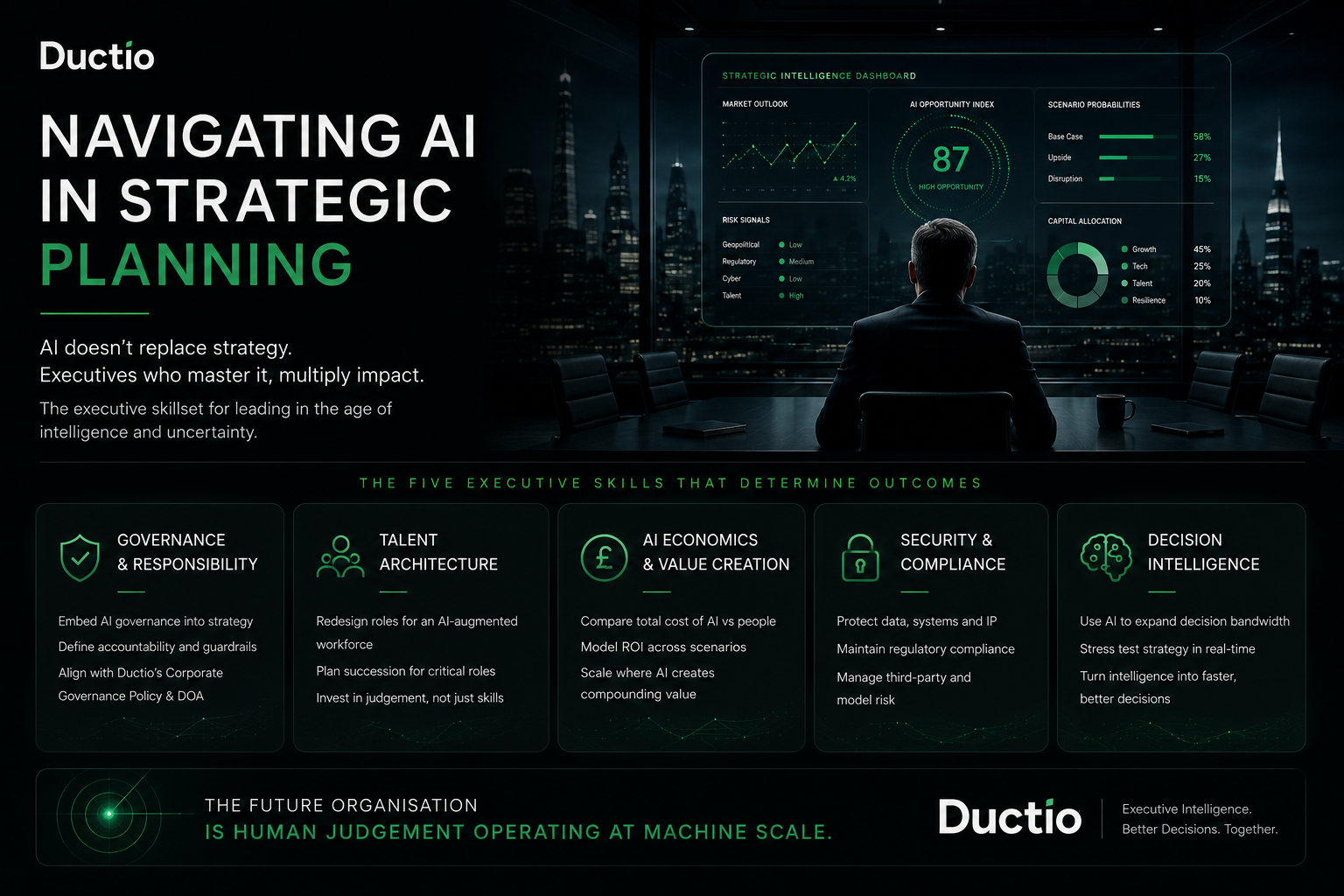
From an executive perspective, navigating AI in strategic planning isn’t about becoming technical. It’s about developing a new set of judgment skills and around capital allocation, talent design, risk, and operating leverage.
Here’s what Executives actually requires:
1. Capital Allocation: Cost of AI vs Cost of People
The first executive mistake is framing AI as a “technology expense.” It isn’t. It’s a labor alternative, a productivity multiplier, and sometimes a new business model.
The right question isn’t:
“How much does AI cost?”
It’s:
“What is the marginal cost of intelligence in our organisation?”
Historically, scaling intelligence meant hiring:
- Analysts
- Coordinators
- Operations staff
- Consultants
Each additional unit of cognitive capacity came with salary, benefits, management overhead, and time-to-productivity.
AI changes the economics:
- Near-zero marginal cost per additional task
- 24/7 availability
- No onboarding lag
- No organisational politics
But executives must evaluate AI investments the same way they would headcount:
- What output is being replaced?
- What level of quality is required?
- What supervision is still needed?
- What failure rate is acceptable?
In many cases, AI doesn’t replace roles; it compresses layers. A team of five analysts may not shrink to one. But it might operate like fifteen.
The real skill here is capital reallocation.
If AI reduces operating cost in one area, are you:
- Improving margins?
- Reinvesting into growth?
- Upgrading talent?
- Or quietly increasing organisational slack?
Strategic discipline matters more than tool selection.
2. Organisational Design: AI-to-Staff Ratios
Every executive team should now be asking:
What is our colleague-to-AI-agent ratio?
Not in a gimmicky way. In an operational way.
If a knowledge worker uses:
- 3 AI agents daily for research, drafting, modelling
- Automation for reporting
- AI copilots for code, design, or analysis
Then that individual’s productive capacity multiplies.
The ratio isn’t about replacing people. It’s about designing roles differently:
- Strategy teams with AI scenario modelling support
- Legal teams with AI contract review
- Finance teams with AI anomaly detection
- Operations teams with AI scheduling and forecasting
The executive skill required here is systems thinking.
Where do AI agents sit in workflows?
Who owns oversight?
How is output validated?
Companies that win won’t be the ones with the most tools. They’ll be the ones that intentionally architect human–AI collaboration.
3. Talent Succession in an AI-Enabled Organisation
This is where things get uncomfortable.
If AI handles first-draft analysis, first-pass research, first-level reporting but how do you train future leaders?
Historically:
- Analysts became managers.
- Managers became directors.
- Directors became executives.
But if AI removes the “apprenticeship work,” you risk hollowing out the development pipeline.
Executives now need to think about:
- How do junior employees build judgment if AI handles execution?
- What experiences are still essential for leadership formation?
- What skills are uniquely human and defensible?
The new promotion criteria may shift toward:
- Critical thinking
- Contextual judgment
- Ethical reasoning
- Cross-functional synthesis
- Decision accountability
AI can generate options. It cannot own consequences.
Succession planning must explicitly design for human capability development and not assume it will emerge organically.
4. Compliance and Security: Governance Is a Leadership Issue
AI governance is not an IT problem. It is an executive responsibility.
There are four core risk dimensions:
- Data leakage
- Model bias and fairness
- Regulatory exposure
- Intellectual property ambiguity
Strategic leaders must ensure:
- Clear AI usage policies
- Data classification standards
- Approved vs non-approved tools
- Audit trails for sensitive decisions
- Human review checkpoints in regulated processes
Security maturity now includes AI literacy.
Questions executives should be comfortable answering:
- Where is our data flowing?
- What proprietary information is being exposed?
- Are we training external models with internal data?
- Who is accountable for AI-generated errors?
If you can’t articulate your AI risk posture to a board or regulator in plain language, governance is not mature enough.
5. Decision Quality: The Executive Edge
AI increases the volume of analysis. It does not guarantee better strategy.
The real skill required at the executive level is judgment amplification:
- Knowing when to trust model output
- Knowing when to override it
- Knowing when to gather more human input
- Understanding probabilistic thinking
AI will often present plausible, polished answers. The danger isn’t obvious error but it’s confident mediocrity.
Strategic leaders must sharpen:
- Scenario thinking
- Counterfactual reasoning
- Sensitivity analysis
- Long-term systems impact assessment
AI accelerates information. Executives still own interpretation.
6. Cultural Signalling: Fear vs Leverage
How leadership talks about AI determines adoption speed.
If AI is framed as:
- A cost-cutting weapon
- A downsizing tool
- A surveillance mechanism
Adoption will stall.
If it is framed as:
- A leverage tool
- A performance enhancer
- A competitive advantage multiplier
You unlock discretionary effort.
Executives must signal clearly:
- AI is here to increase capability, not reduce dignity.
- Human judgment remains central.
- Learning and experimentation are encouraged.
Culture, not tools, determines whether AI becomes advantage or distraction.
7. The Strategic Planning Shift
Traditional strategic planning cycles were annual. AI compresses feedback loops.
You can now:
- Run dynamic market simulations
- Model multiple pricing scenarios instantly
- Analyze customer sentiment in real time
- Stress test capital allocation assumptions quickly
This shifts planning from static forecasting to continuous recalibration.
The executive skill required here is comfort with iteration.
Plans become hypotheses.
Strategy becomes adaptive.
Leaders who cling to static five-year roadmaps will struggle in AI-accelerated environments.
The Executive Skill Stack for the AI Era
Navigating AI strategically requires:
- Economic literacy in cost substitution
- Organisational design thinking
- Talent architecture awareness
- Governance and compliance fluency
- Probabilistic decision-making
- Cultural leadership
AI is not a technology project. It is a structural shift in how intelligence is produced inside the firm.
The executives who thrive will not be those who know how to prompt a model.
They will be the ones who know how to redesign an organization around it.