
Executive Hiring
Leadership Talent
Thought Leadership

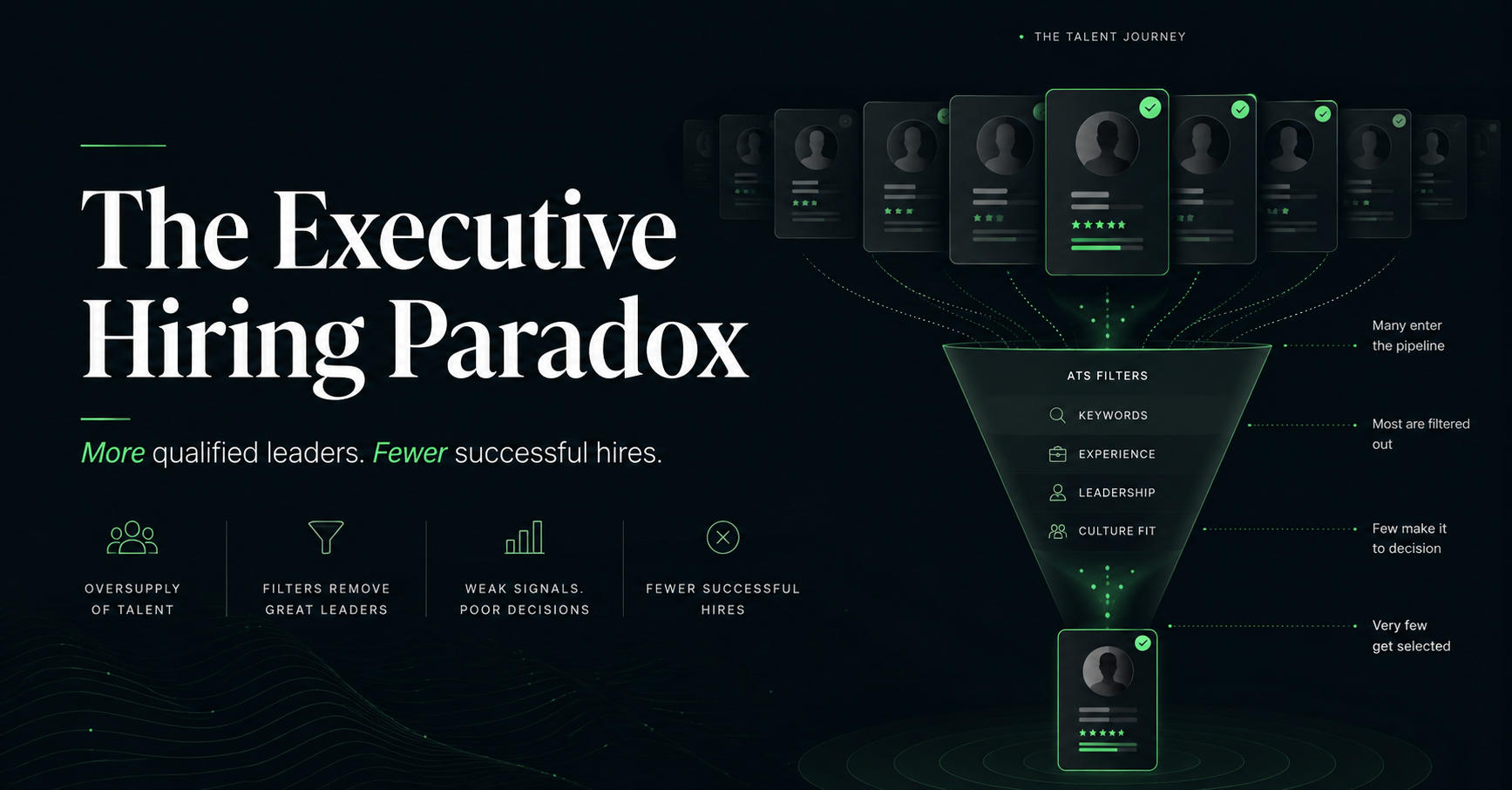
The hiring market is becoming more automated at exactly the same time that leadership roles are becoming harder to define.
That creates a problem.
For years, executive search has largely started with the same building blocks: a job description, a target list of companies, a candidate's career history, a network of contacts and a series of interviews.
Those signals still matter. But they are no longer enough.
AI is changing what executives actually do. It is changing the skills organisations need. It is allowing candidates to produce increasingly polished applications. It is helping recruiters search larger talent pools. And it is creating new questions about what information should be trusted, verified and ultimately used to make a hiring decision.
Gartner's Q3 2026 CHRO research illustrates how quickly the underlying workforce is changing. More than half of employees surveyed are already using AI for a core responsibility, while 40% of CHROs say their organisations have already redefined roles or skills because of AI. Gartner also reports that 86% of HR leaders believe traditional leadership competencies need to be updated.
For executive search, the conclusion should be uncomfortable.
If the role is changing, the way we search for the person must change with it.
Most executive searches begin by defining experience.
Ten years in the sector. Previous divisional P&L responsibility. International experience. A particular qualification. Experience at a recognised competitor. Perhaps previous CEO or CFO experience.
These are useful filters, but they are proxies.
They do not necessarily tell us whether someone can solve the problem the company is about to face.
The World Economic Forum expects 39% of workers' existing core skills to change by 2030. AI and big data are among the fastest growing skills, but so are resilience, flexibility, leadership, social influence and analytical thinking.
At the very top of organisations, the shift is already visible. Korn Ferry's 2026 CEO and Board research found AI and technology proficiency becoming a major leadership priority across sectors. Yet only 30% of board respondents expressed confidence in their organisation's ability to manage AI and future technology risks.
The search brief therefore needs to move beyond "Who has done this job before?"
It needs to ask "Who has demonstrated the capabilities required for what this company is about to go through?"
Executive search should start with the business context before it starts with the candidate.
A leader who produced 15% EBITDA growth in a rapidly expanding market has not necessarily demonstrated the same capability as somebody who produced the same result while restructuring a declining business.
Likewise, somebody who scaled a £200 million founder-led company may have very different evidence behind them from somebody running a £2 billion division inside a highly structured multinational.
The outcome might look identical on a CV.
The context is not.
Future executive search will increasingly need to understand the relationship between the executive, the company, the market and the outcome.
That means examining what the business looked like when the executive arrived, what changed during their tenure, what happened to financial and operational performance, what happened to the leadership team, what external conditions existed and what evidence suggests the executive actually contributed to the outcome.
This shifts executive assessment from career matching towards evidence-based leadership intelligence.
AI has dramatically reduced the cost of producing a credible application.
That is good for candidates, but it also creates an information problem for recruiters.
Greenhouse reports that 78% of candidates surveyed across the UK, Ireland and Germany use AI to tailor CVs or applications. It also says recruiters are dealing with nearly three times as many applications per role as they were in 2021.
The Financial Times recently described employers moving back towards referrals, recommendations and deeper human assessment as AI-generated CVs and cover letters make conventional applications increasingly difficult to differentiate.
There is also a more serious verification problem emerging. Greenhouse's wider research found significant recruiter concern around misrepresentation, AI-generated work and candidate identity.
At executive level the issue is slightly different.
A senior executive is unlikely to submit hundreds of automated applications, but the information problem remains.
A CV tells you where somebody worked.
LinkedIn tells you what they say they did.
An interview tells you how convincingly they can explain it.
None necessarily proves contribution.
The next generation of executive search should distinguish between claimed evidence and observable evidence.
If an executive claims to have transformed a company, what changed?
If they claim to have grown a business, how did revenue, margin, headcount, market share or valuation move during the relevant period?
If they claim M&A experience, which transactions occurred and what role did they appear to play?
If they claim to have built a leadership team, who joined, who left and what happened subsequently?
If they were successful in one environment, what evidence suggests the same capabilities transfer to another?
None of these questions should allow an algorithm to declare somebody a "good" or "bad" executive.
They should give the recruiter something much more valuable: better questions to ask.
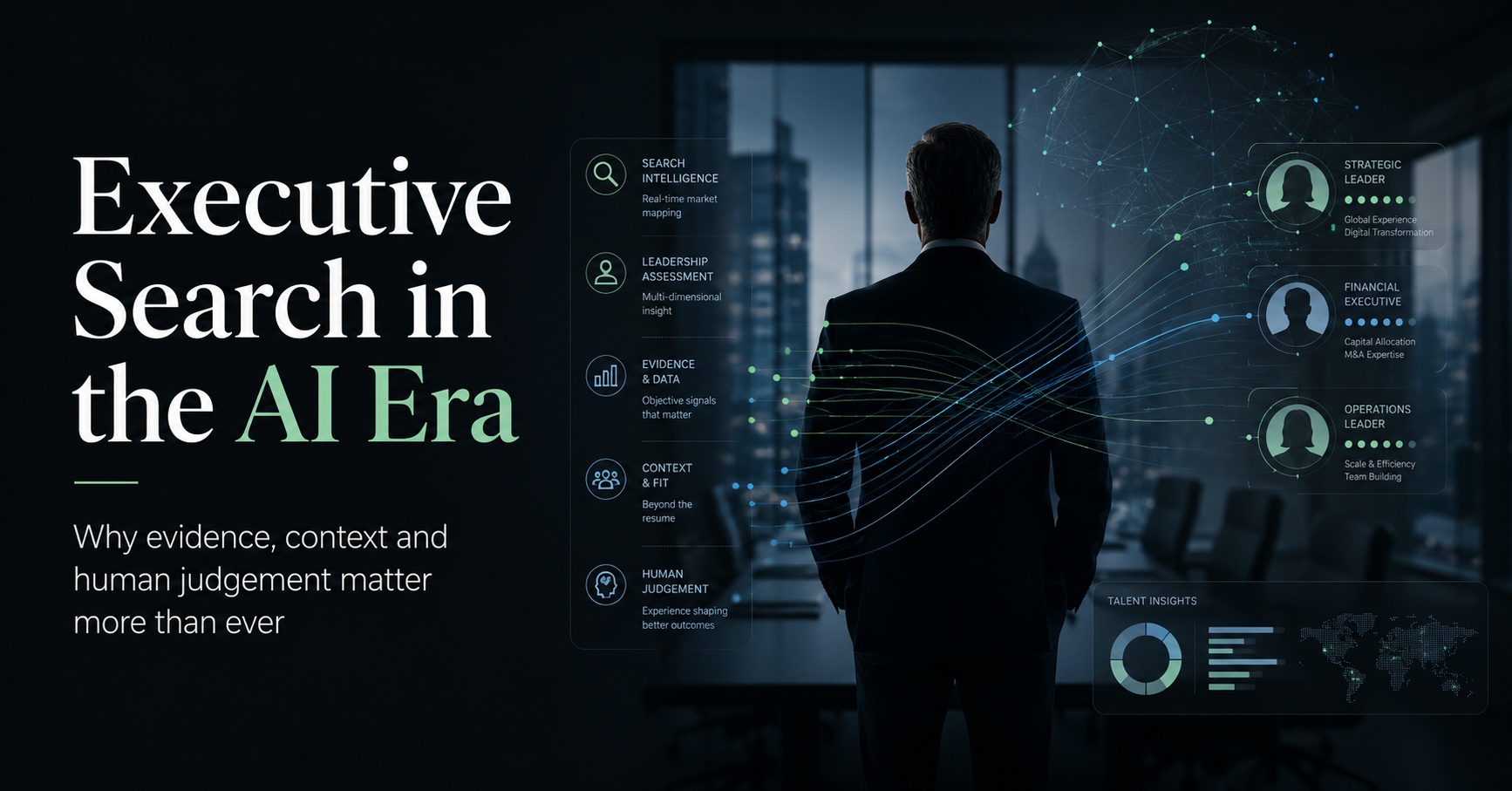
AI should help expose evidence, contradictions, patterns and missing information. Human judgement should interpret it.
That distinction is going to become increasingly important.
Recruitment technology has historically been very good at optimising activity.
More candidates sourced. More profiles screened. Faster outreach. Faster scheduling. Faster shortlists.
The harder question is whether any of this improves the eventual hire.
LinkedIn's research into search and staffing firms found that 80% were exploring, experimenting with or actively integrating generative AI. Yet the same research suggests the industry is increasingly shifting its attention from recruitment efficiency towards quality of hire.
Some 85% of recruitment professionals said measuring quality of hire would become increasingly important, while only 47% were highly confident that their organisation could measure it effectively. Sixty-two percent believe AI could help.
That gap matters.
If recruitment technology makes a poor selection process twice as fast, it has not improved recruitment.
It has simply accelerated the mistake.
AI's most valuable role in executive search may not be deciding who should be hired.
It may be improving the information available to the people making the decision.
Imagine the difference between asking:
"Find me CFOs from FTSE 250 companies."
and asking:
"Find finance leaders who entered complex organisations during a period of margin pressure, subsequently improved profitability, have evidence of transformation experience, have operated across several countries and appear ready for a broader CFO mandate."
The first query searches a database.
The second begins to investigate a leadership hypothesis.
That is where executive search becomes substantially more interesting.
Technology can help researchers examine thousands of executives, companies, career moves, financial events, transactions and leadership changes. But the objective should not be to automatically rank human beings from one to one thousand.
The objective should be to reduce the enormous information asymmetry that exists before a recruiter or board meets a candidate.
Regulators are increasingly drawing the same distinction.
The UK Information Commissioner's Office reported in 2026 that many employers using automated recruitment tools were likely making solely automated decisions without sufficient safeguards. Its expectations include greater transparency, meaningful human involvement and active monitoring for bias.
The EU AI Act also explicitly identifies AI used to analyse applications and evaluate candidates as a potentially high-risk employment use case. Following the 2026 AI Omnibus changes, the main high-risk employment obligations are scheduled to apply from 2 December 2027.
For executive search platforms, the direction should already be obvious.
Use AI to increase intelligence, not remove accountability.
One of the strangest features of executive recruitment is that organisations routinely spend years developing products, customers and acquisition pipelines, yet can start looking for their next CEO only when the existing one announces their departure.
Korn Ferry's 2026 research found that half of boards believed succession planning began too late during their last CEO transition. Only 15% felt their organisation did a very strong job preparing its first-time CEO.
Spencer Stuart similarly argues that succession should become an ongoing process rather than an event, with organisations maintaining both internal development and external market perspectives. Its European CEO research shows why this matters: external appointments again represented the majority of European CEO appointments during 2025, although large companies continued to rely heavily on internal successors.
Succession planning and executive search are gradually becoming the same intelligence problem viewed at different points in time.
A board should not first discover the external CEO market when it needs a CEO.
It should already understand it.
Who are the credible successors inside the company?
Who sits one role below them?
Who are the emerging executives elsewhere in the market?
Which candidates have operated in similar circumstances?
Who has moved into a position that could accelerate their readiness?
Which leaders are gaining experience relevant to where the company's strategy is heading?
And critically, how does the internal bench compare with the external market?
This creates a fundamentally different model of succession.
Instead of producing a static succession document once a year, organisations can maintain a living map of leadership capability.
The question changes from:
"Who could replace the CEO today?"
to:
"Who might be capable of leading this company under each of the scenarios we could face over the next three to five years?"
That is a much more powerful question.
The biggest change ahead may therefore have very little to do with sourcing.
There will always be databases.
There will always be professional networks.
There will always be recruiters who know exceptional people.
What changes is the amount of intelligence available before a decision is made.
LinkedIn's Future of Recruiting research found that 89% of talent acquisition professionals expect measuring quality of hire to become increasingly important, yet just 25% said they were highly confident their organisation could do it effectively.
Executive search firms should eventually be judged on more than whether the placement survived its guarantee period.
Did the executive deliver against the reason they were hired?
Did the company improve?
Did the leader build the organisation required for the next stage?
Did the predicted strengths actually show up?
Which evidence used during the search proved predictive, and which did not?
Those answers create something recruitment has historically struggled to build: a feedback loop.
And once that feedback loop exists, executive search starts becoming smarter with every appointment.
AI will not remove the need for executive recruiters.
It may do the opposite.
As information becomes easier to create, the ability to determine what information deserves to be trusted becomes more valuable.
As candidate pools become larger, judgement becomes more important.
As leadership roles change more quickly, understanding business context becomes more important.
And as organisations become capable of analysing far more information about potential leaders, governance, transparency and human oversight become essential.
The winning executive search model is therefore unlikely to be "AI replaces the headhunter."
It is more likely to be:
AI finds the evidence.
Data establishes the context.
The recruiter asks better questions.
The board makes the decision.
Outcomes tell us whether we were right.
That is a very different proposition from searching CVs.
And it is where executive search is heading.