
Executive Hiring
Executive Intelligence
Executive Recruitment


Executive recruitment has an information problem, and it is not the one most people assume. The constraint is not a shortage of candidate data. Platforms today can search more than a billion profiles, parse career histories at scale, and rank executives by algorithmic relevance before a researcher has opened a spreadsheet. The constraint is that this information tells you where someone has been, not what they are capable of doing next.
Between 30% and 50% of senior executive hires derail, underperform, or exit within 18 to 24 months. That range has remained stable for decades across longitudinal studies. It has not budged despite the arrival of bigger databases, faster screening, and more sophisticated keyword matching. The persistence of that failure rate tells us something structural: the tools are improving at the wrong layer of the problem. They are getting better at finding executives. They are not getting better at evaluating them.
At Ductio, we have spent years studying where this gap sits and what it takes to close it. The argument that follows is not a case for abandoning recruitment platforms. It is an argument for understanding what they measure, what they miss, and where the real assessment work begins.
The mapping case for AI and platform technology is genuine. AI now reads public career data at a scale no human research team can match. It builds longlists from the open market, models competitor organisational charts, tracks compensation movement, and flags executives whose situation may be changing. Top-performing search firms are roughly four times more likely to use AI than their peers, and almost entirely for mapping and market intelligence.
The error begins when the map is mistaken for the decision.
A platform can tell you that a CFO spent six years at a listed industrial company, held a prior role in private equity, and completed an MBA at a target institution. What it cannot tell you is whether that CFO personally drove the capital allocation decisions that produced the financial outcomes on the balance sheet, or whether those outcomes were driven by commodity price cycles, a predecessor's strategy, or a strong finance team operating below the executive. The distinction matters: it is the difference between hiring a leader who creates results and hiring a leader who was present when results occurred.
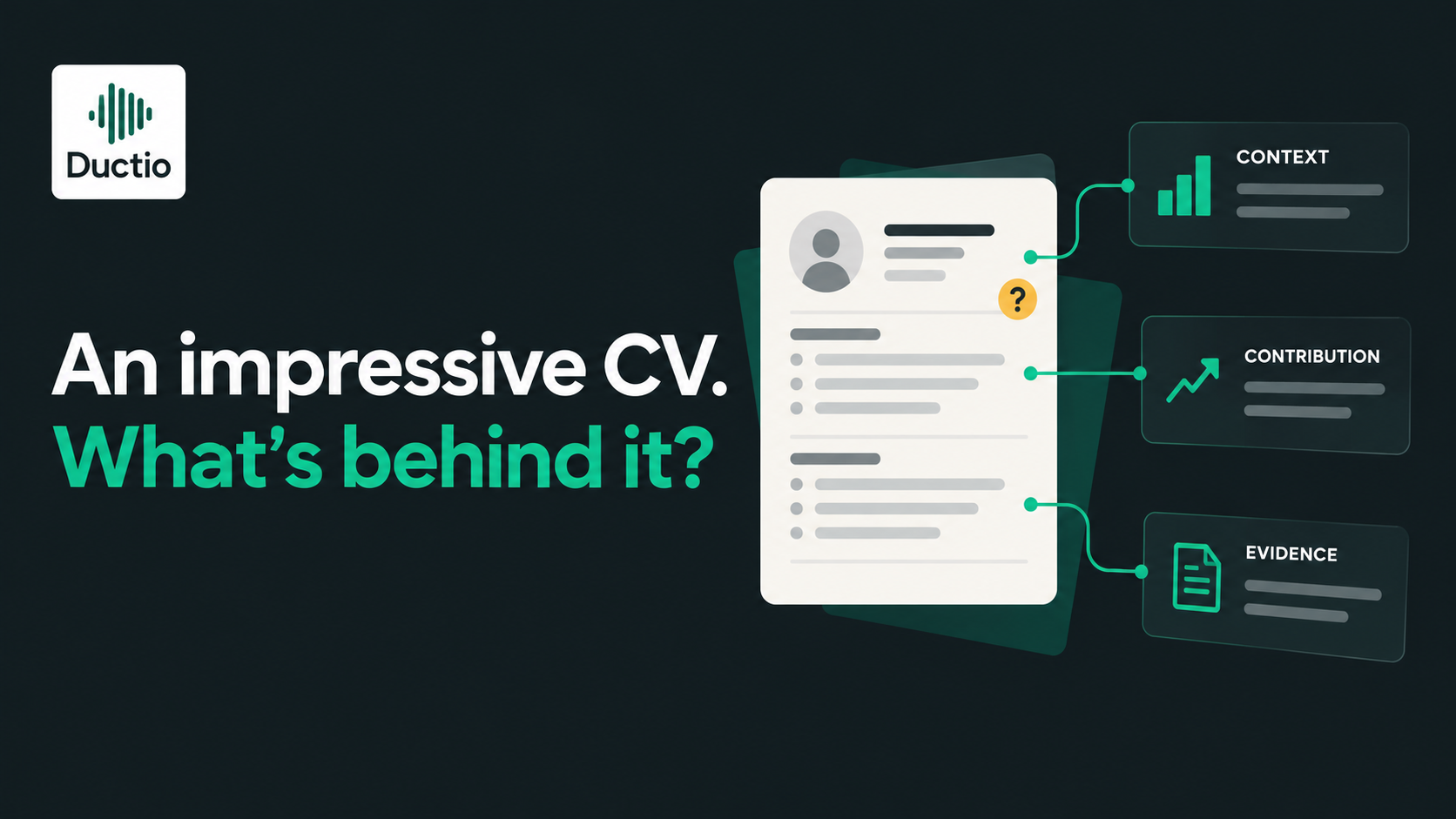
This is what we at Ductio call the gap between claimed evidence and observable evidence. Claimed evidence is what appears on a CV and in an interview: the narrative a candidate constructs about their own contribution. Observable evidence is what financial statements, governance filings, market conditions, and organisational context reveal about what actually happened during that executive's tenure, and how much of it can reasonably be attributed to their decisions.
Most executive platforms operate entirely within the claimed-evidence layer. They process the CV. They index the LinkedIn profile. They match keywords. They do not connect leadership activity to financial and operational outcomes, and they do not control for the market conditions that make attribution so difficult.
A CV is an input document, not an assessment tool. At the mid-career level, it functions reasonably well because the relationship between experience and capability is relatively direct: a software engineer who has shipped production code can probably ship more production code. At the senior leadership level, that relationship breaks down.
A perspective published in the International Journal of Selection and Assessment in October 2026 (Sehm, 2026) argues that the central validity problem in executive selection is not predictor optimisation but criterion specification. In plain terms: organisations often fail at executive hiring not because they lack good tools for measuring candidates, but because they have not defined what they are measuring against. Career history, personality, and reputation cues are treated as substitutes for criterion definition, when they should be treated as evidence that depends on what those criteria actually are.
This framing matters because it exposes the deepest limitation of platform-based assessment. A platform can tell you what a candidate has done. It cannot tell you what the role actually requires in the context of this organisation, at this stage of its development, facing these specific market conditions. That translation from organisational context to executive capability profile is the analytical step that platforms skip entirely.
The evidence on interview reliability points in the same direction. Structured interviews have meaningful predictive validity. Unstructured interviews, which remain the dominant format for senior appointments, add noise. Research on overconfidence in interview-based selection decisions has shown that unstructured interview information can hurt hiring decisions by inflating the evaluator's confidence without improving their accuracy. Boards and hiring committees often feel more certain about a candidate after an unstructured conversation, not because they have learned something predictive, but because the conversation has given them a coherent story that feels right.
If CVs measure history, and interviews measure presentation, then where does leadership potential sit?
The Ductio view is that leadership potential is observable, but not where most platforms are looking.
It sits in the relationship between an executive's decisions and the outcomes those decisions produced, measured against the conditions in which those decisions were made. It sits in patterns of capital allocation across multiple roles: does this executive consistently improve operating leverage, or does their track record correlate with favourable market conditions they did not create? It sits in governance behaviour: how does this executive respond when the board questions a strategy, when regulatory pressure intensifies, or when a business unit requires restructuring rather than growth?
These are not abstract qualities. They leave evidence in financial filings, in the timing of organisational changes relative to market shifts, in the gap between announced strategy and delivered results, and in the way companies perform before, during, and after an executive's tenure. The difficulty is that this evidence is scattered across financial statements, regulatory filings, company announcements, news coverage, and market data. It requires assembly, contextualisation, and analytical framing before it becomes useful for assessment.
Platform-based assessment does not do this work. It treats the candidate's self-reported career as the primary data source and supplements it with keyword matching against a job specification. That is why an executive who presents well in interviews, holds the right titles, and maintains a polished LinkedIn profile can pass through every platform filter and still fail within 18 months. The filters measured the wrong things.
The persistence of a 30% to 50% senior-executive failure rate across decades of studies is itself a data point worth examining. Hiring technology has improved dramatically. Databases are larger. Search is faster. AI sourcing tools can process information at a scale that would have been unimaginable ten years ago. Yet the failure rate has not meaningfully declined.
The reason is structural. The technology improvements have all occurred at the sourcing layer: finding candidates, ranking profiles, matching keywords. The assessment layer, where organisations determine whether a specific candidate will succeed in a specific context, has remained stubbornly manual, subjective, and under-evidenced.
Consider what happens in a typical senior executive appointment. A search firm or internal team produces a longlist. That longlist is narrowed based on CV review and initial conversations. A shortlist of three to five candidates enters a formal interview process with the board or hiring committee. The committee meets each candidate two or three times, often in unstructured settings. References are collected, frequently from people the candidate has nominated. A decision is made.
At no point in this process does anyone systematically connect the candidate's claimed achievements to the financial and operational performance of the organisations they led. At no point does anyone control for market conditions, predecessor effects, or team quality. At no point does anyone ask whether the candidate's track record predicts success in the specific context of the hiring organisation, or simply demonstrates that the candidate has held progressively senior titles.
The platforms that support this process make it faster. They do not make it more accurate.
Closing the gap between platform capability and assessment accuracy requires measuring different things, not measuring the same things faster.
Four areas carry the highest signal for senior leadership potential, and none of them are well served by current platform technology.
First, contextual performance attribution. Did this executive create the outcomes they claim, or did they inherit favourable conditions? Answering this requires connecting leadership tenure to financial performance while controlling for market conditions, predecessor decisions, and team composition. Perhaps 20% of a company's financial performance during an executive's tenure is attributable to that individual. Perhaps 60%. The honest answer is that we often do not know precisely, and the analytical discipline required to narrow that uncertainty is itself a differentiator.
Second, transferability analysis. An executive who succeeds in a stable, listed industrial company may not succeed in a venture-backed growth business. An executive who thrives in a founder-led culture may fail in a private-equity portfolio company with quarterly reporting cadence. The question is not whether the candidate has relevant experience, but whether the conditions under which they succeeded are sufficiently similar to the conditions of the new role. This requires structured comparison of operating environments, not CV pattern matching.
Third, governance and risk behaviour. How does this executive behave under pressure? Do they make different decisions when facing regulatory scrutiny, activist investors, or a business in decline? These patterns are visible in public records, in the timing of strategic shifts, in how companies disclose risk, and in what happens to organisations after the executive departs. They are not visible on a CV.
Fourth, succession and development trajectory. Where is this executive headed, and does the trajectory match the hiring organisation's three-to-five-year needs? An executive at the peak of their capability today may not be the right choice for a role that will require adaptation to a market that shifts significantly over the next several years. Assessing trajectory requires understanding not just what the executive has done, but the rate and direction of their capability development across roles.
The practical implication for executive search buyers and talent leaders is direct: platform data is a starting input, not a finishing line.
You should expect your assessment process to answer questions that no platform currently asks. What changed at the companies this executive led, and how much of that change is attributable to their decisions? How do their results compare to executives who operated in similar conditions? What do the governance filings, financial statements, and organisational changes tell us about their decision-making patterns, as distinct from their self-reported narrative?
These questions require an intelligence layer that sits above and between the data sources that platforms already collect. It requires connecting executive career history with company performance, organisational context, and external market signals into a coherent analytical framework.
This is the work Ductio is building: not a faster way to search CVs, but a structured intelligence layer that connects leadership decisions to measurable business outcomes. We call it executive intelligence, and it is a fundamentally different proposition from keyword matching, profile ranking, or algorithmic scoring against job descriptions.
The organisations that distinguish between claimed evidence and observable evidence in their executive appointments will make better decisions. They will reduce the proportion of senior hires that fail within 18 months. They will build institutional knowledge about what leadership success looks like in their specific context, rather than starting from scratch with every appointment.
And once that feedback loop exists, where the outcomes of executive appointments inform the criteria for future ones, executive search starts becoming structurally smarter with every hire. That is a very different proposition from searching CVs. And it is where executive assessment is heading.